Choose two beautiful bridges and identify the structural elements and the stress they are bearing.
Represent the system, label its parts (elements and stresses) and give a brief explanation of the structural elements as the example shows.
Example of the activity:
This video can help you oing this project:
Steps to do the activity:
1. Choose the structure
2. Identify the structural elements and stress forces using the notes and all you have learnt in class
3. Prepare a document (google jamboard or any other whiteboard)
4. Point and label its parts as it is shown in the example
5. Include brief explanation about the the structural elements
6. Include the title block with your name and all information needed. Include there information about the strucrure. (where the bridge is, what type of bridge it is ...)
7. Export the document as a pdf or image format
8. Upload the two activities in your EducamosCLM site class
9. You have to do two bridges
Example with another structure (swing), but you have to do it with a bridge:
One of the most amazing structures on Earth are Bridges.
We are a species of bridge builders. Since time out of mind, humans have engineered structures to solve obstacles, such as, say, Jiaozhou Bay. There, there is now a 42.5-kilometer bridge that links the busy Chinese port city of Quingdao to the Chinese suburb of Huangdou.
In addition to this we have tamed steel or stone in an effort to reach the places, people and things we desire.
Although the concept itself is as simple as felling a tree across a creek, bridge design and construction make artists, architects and engineers to reshape the very environment in which we live.
As a result, we inhabit a planet of bridges, some as ancient as Greece's 3,000-year-old Arkadiko bridge or as unchanged as India's 500-year-old Meghalaya living bridges, which are coaxed into existence from growing tree roots.
There are many types of bridges and we are going to study and classify so that you are able to understand how they work.
The main elements that bridge designers use to make a bridge successful are beams, arches, trusses and suspenders, and they make the pure types that we can find: beam, truss, arch and suspension bridges.
The key differences between the bridge types comes down to the lengths they can cross in a single span, which is the distance between two bridge supports, the physical braces that connect the bridge to the surface below. Bridge supports may take the form of pillars, towers or piers...
Types of bridges
Beam Bridge
If you want to build a beam bridge (also known as a girder bridge), all you need is a rigid horizontal structure (a beam) and two supports, one at each end, to rest it on. These components directly support the weight of the bridge and any traffic traveling over it. They are not very interesting to study because of its simple design, but some amazing new designs have a beam bridge as a part of it. Oresund Bridge in Sweden is an example of this.
Truss Bridges
In order to help the beam to be stronger engineers have developed several types of beams, all made with triangulated shapes.
The Forth Bridge in Edinburgh is a cantilever bridge, and you can see trusses in lots of the new designs.
Arch Bridges
After more than 2,000 years of architectural use, the arch continues in bridge designs and with good reason: Its semicircular structure elegantly distributes compression through its entire form and diverts weight onto its two abutments, the components of the bridge that directly take on pressure. Modern arch bridges like Garabit Viaduct, Yajiesha Bridge (Guangzhou) or Chaotianmen Bridge, are not pure arch but truss arch bridges
Suspension Bridge
As the name implies, suspension bridges, like the Golden Gate Bridge or Brooklyn Bridge, suspend the roadway by cables, ropes or chains from two tall towers. These towers support the majority of the weight as compression pushes down on the suspension bridge's deck and then travels up the cables, ropes or chains to transfer compression to the towers. The towers then dissipate the compression directly into the earth.
Examples of suspension bridges are Bosporus Bridge, Brooklyn Bridge or Golden Gate Bridge
Cable-stayed Bridge
At first glance, the cable-stayed bridge may look like just a variant of the suspension bridge, but don't let their similar towers and hanging roadways fool you. Cable-stayed bridges differ from their suspension predecessors in that they don't require anchorages, nor do they need two towers. Instead, the cables run from the roadway up to a single tower that alone bears the weight.
The tower of a cable-stayed bridge is responsible for absorbing and dealing with compression forces. The cables attach to the roadway in various ways. For example, in a radial pattern, cables extend from several points on the road to a single point at the tower, like numerous fishing lines attached to a single pole. In a parallel pattern, the cables attach to both the roadway and the tower at several separate points.
Millau Viaduct in France and Octavio Frias de Oliveira Bridge in Brazil are good examples
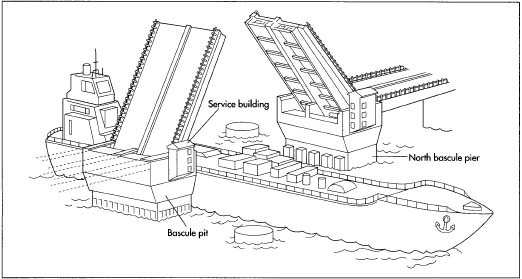
Draw-Bridge
Type of bridge that can be open to let boats or ships sail under their decks.
The Tower Bridge in London is a very famous example of this type and Gateshead Millenium Bridge is an incredible and original design.